The books range on length from novels (60-130,000 words) to novellas (20-40,000 words). My books do have sex between consenting adults. The novellas are mostly ♥♥♥. Novels are ♥♥♥♥. There is some violence and mild profanity.

------holding hands, perhaps a gentle kiss
♥♥ ---- more kisses but no tongue-- no foreplay
♥♥♥ ---kissing, tongue, caressing, foreplay & pillow talk
♥♥♥♥ --all of above, full sexual experience including climax
♥♥♥♥♥ -all of above including coarser language and sex more frequent

Thursday, October 31, 2013

So what really happened-- give or take a lie or two

There is historical truth. Something really did happen a certain way. The question is how do we find it when we are not living in the era in which the event happened (often even when we are)? This is especially true of something with a lot of emotional energy attached.

Well, we can rely on eyewitness accounts which were written down not long after the event occurred. The problem with that is that people don't always see the same things nor do they always tell the truth. Excitement, mythology, hearing the stories of others, all if it can impact what comes out with diverse versions. When you hear someone else say what they saw pretty soon it can seem like you saw it.


Where it comes to George Armstrong Custer, I've looked at a wide variety of sources to try and discern what I think happened at The Little Bighorn as well as what led up to it. My original motive to understand the cavalry of that time morphed into trying to understand this complicated man and the time in which he was operating.

Pretty soon I went to documentaries. The one below at 45 minutes explains a logical approach to Custer's motives that day and how he ended on what is called Last Stand Hill. It uses commentary, reenactments and maps that trace the actions and routes of the various participants.


Didn't like that or consider it to be your idea of what you were told happened? Not politically correct for your time? Okay, give archaeologists a try as they went in with modern equipment and tools to find what was left over a hundred years later regarding where soldiers died, how the event went down (not that archaeology can determine timing). They also used the stories the Indians told because they were the only ones who survived Last Stand Hill which the archaeologists in this documentary (also 45 minutes) decided was misnamed.


After all the books I've read on this, having been to The Little Bighorn the first time when it was called Custer Battlefield NM (politically correctedness impacts history if you didn't already know that), I think the archaeologists made one big goof in their analysis, but they had some very interesting results. Just remember, archaeology can dig up inanimate objects (including human bones) it will always be a human assessing the story behind them.

My disagreement with them comes from their ignoring something that intervened between the battle and their collecting specimen. Because they found very few cartridges from the soldiers in the area Custer and those closest to him fell, they decided they hadn't fired many shots up there.

They did know more or less who fired the bullets as the Indians, who were very well armed thanks to the Bureau of Indian Affairs (for hunting buffalo dontchaknow), with repeating rifles-- Henrys as well as assorted other weapons. Henrys are not as accurate at a far distance but close up they are deadly for how fast they can be shot. The cavalrymen were shooting Springfield carbines where you had to load each bullet. Deadly at a distance (for those who had time to practice and most agree these green troopers had not) but way disadvantaged close up.

Another point they ignored -- Custer, his brothers and probably other officers, had purchased their own weapons as they felt what the military offered was inferior. Did they factor that in? Didn't sound like it.

So when the archaeologists found few spent cartridges of the military type expected on the hill but lots more down in the gulch where they assessed the soldiers had run after the hill was taken (based on Indian oral stories), they decided little firing was done on the hill.

That ignored souvenir scavengers which everyone knew had been combing that hill for years from right after the massacre. Not many casings from a Springfield found up there makes total sense in that situation. That more would be below also makes sense since human scavengers wouldn't know about the fighting below or go where they'd expect less to be found. Heck even reloaders back then might have wanted those spent cartridges.

Those archaeologists apparently used oral histories only that suited their agenda. You think they didn't have an agenda. Everyone who has been intrigued by the Custer/Crazy Horse story has an agenda!

It appears I've used up my space here but I will relate what I think happened based on reading a lot of biographies, Custer's own words from his book, and a lot of analysis from experts.

It might seem I spent a lot of time on Custer, but I learned so much about the problems and psyche of military men of that time about the fighting that was going on. I think I better understand who my hero was based on the things I read about Custer-- but I'm not done with him. Custer is the mythological hero but he was a real, flesh and blood man. How we see him might impact how we see many other things including the Civil War and the Indian Wars across not only the Plains but the whole nation.

Tuesday, October 29, 2013

mythology and the hero

You can lose a battle and win a war 
or likewise win a battle and lose a war.

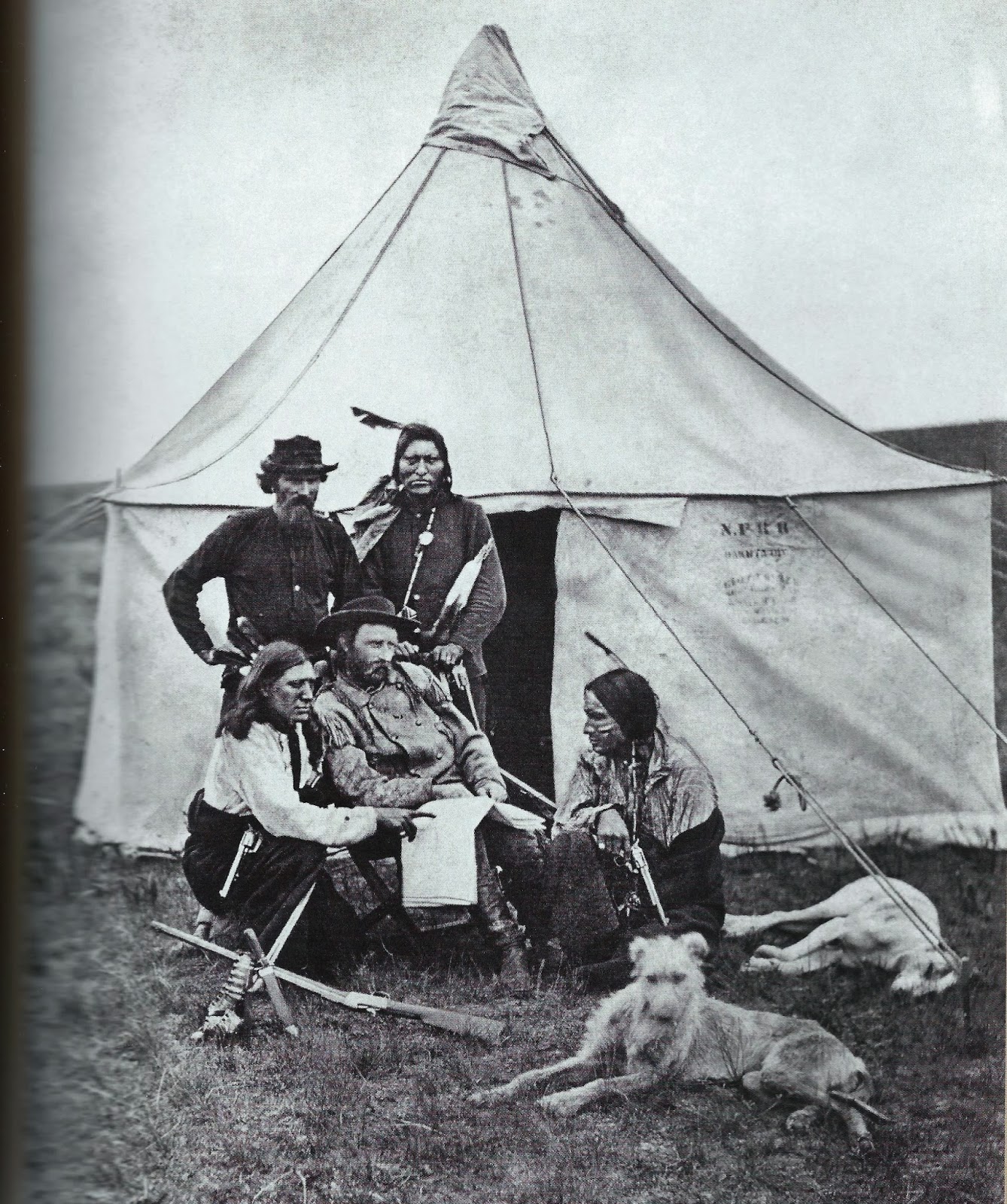
Custer with his scouts 1874-- Library of Congress photo

To understand my cavalry hero for the fourth Oregon historical, I needed to understand the military. When you write about an abstract outlaw, sheriff, rancher, etc., you can play loose with the likely facts but the military has certain absolutes-- or does it? I needed to understand the military of that time. Who better or more written about than George Armstrong Custer?

Some think Custer was made famous by his death at the Little Big Horn. That's not true. He was a celebrity in his own time. His death shocked the nation-- some say as much as JFK's assassination did a later generation. He was politically popular and many think he planned to run for president which considering past candidates isn't impossible. He was immediately blamed for his own actions that day and equally quickly mythologized for the same reason.
 "When a person becomes a model for other people's lives, he has moved into the sphere of being mythologized." Joseph Campbell, The Power of Myth
Yes, he did have an ability to tell his own story in a way that excited others. When you read his own words in the book he wrote about his life on the plains, he was as effusive in praising others as admitting mistakes he himself made. He comes across as a very likeable man. He was however a man who gave orders, expected discipline from others as he did from himself. He was a teetotaler in a group where heavy drinking was more the order of the day. His physical attributes are definitely part of what led to the mythology. The daring man who can ride all night and fight all day is still a powerful hero image.

Certainly after his death, his widow worked to get out stories he hadn't told, to make sure people saw him as a dedicated man who had fought for the good of all. On the positive side, there were others who added to the mythology. In 1877 when interviewed by a reporter for the New York Herald, Sitting Bull told the story of what he remembered of how Custer died.
Sitting Bull: Up where the last fight took place, where the last stand was made, the Long Hair stood like a sheaf of corn with all the ears fallen around him.
Reporter: Not wounded?
Sitting Bull: No.
Reporter: How many stood with him?
Sitting Bull: A few.
Reporter: When did he fall?
Sitting Bull: He killed a man when he fell. He laughed.
Reporter: You mean he cried out.
Sitting Bull: No, he laughed. He had fired his last shot.
Was this the truth? Was Sitting Bull carrying on a mythology which had also been powerful among the tribes? Who can know. There are as many versions of how Custer died as you could find for any famous event in history. The facts that can be agreed upon were that he was a very young man to acquire leadership. He was quite disciplined, strong, athletic and he demanded discipline from those who served under him which was resented.

Some adored him and others hated him. Just before his death he had been called back to Washington to testify at a corruption trial of President Grant's Secretary of War. Custer testified that they were sending inferior food to the reservations as well as the troops. That and other times he had spoken out earned him Grant's enmity. His having to go there at that time, spend time testifying and then waiting to be released to head West was a factor in the failure at the Little Bighorn. He would have rather been training his troops, getting them ready. Instead that fell to Reno who didn't do much about it. The Seventh that went into battle weren't the equivalent of troops he'd taken with him before when he'd had time to toughen and strengthen their skills. 

Some writers, as did Stephen E. Ambrose in Crazy Horse and Custer, recognize the hero but also the fallible human who could make a mistake-- perhaps for political purposes; but then be willing to pay the price. That is courage either way. I liked James Donovan's, A Terrible Glory for how it showed politics as playing a big role in what happened and its aftermath for both the military, the nation, and the Sioux.

When I got through reading the various versions of the Little Big Horn that day, it was clear that nobody could know for sure how Custer himself died. There are a multitude of explanations for how he had been shot twice, his body was stripped, but not mutilated (beyond holes in both ears and some saying they had poked an arrow up his penis... not sure what meaning that had but the ear holes were to make him hear better next time). I'd read he wasn't scalped because he was balding except that made no sense. Custer always had a high forehead. Most books say he had cut his hair short and it explains it. A few have other, juicier explanations.

This research has helped me understand a lot of how my cavalry officer's life would have been. He was a West Pointer like Custer. He also served in the Civil War as well as fought Indians. Although the battles my hero was engaged in were taking place in Oregon and Custer's were out on the Plains, in a fictional sense, they might they have known each other. My hero would have been the older by 7 years.

Whether Custer was a bad guy or a hero is still hotly debated. Yes, after reading so many books (who could possibly read them all), I have an opinion. Between the letters husband and wife exchanged, their own books of their experiences, I also have an opinion on their marriage. Does my opinion on that or Custer's character make any of it fact?


mealtime, Big Creek Kansas 1869 as Elizabeth went with him wherever possible

What I don't think can be debated is that the United States didn't act honorably with how it took the Black Hills, Pahá Sápa, from the Sioux and cheated them in the doing. The quest Custer was on was one assigned him by Grant and Sheridan. One wanted the land. The other wanted Indians killed. Sheridan famously had said the only good Indian was a dead one and that even though, while earlier serving in Oregon, he had had an Indian mistress whom he left to fight in the Civil War. Custer's death served both purposes more admirably than his surviving and gaining even more fame would have. Was there a conspiracy? Who can know but there are those who profited by the emotional anger stirred up at Custer's death and weren't sad to see him out of the way.


Having been to much of this country, where it is said Crazy Horse was born and later secretly buried, I have strong feelings about what happened. It is said in my family that my grandfather was the first white baby born in the illegally taken land of the Black Hills when his father went there to mine for gold. I've often thought if reincarnation is true, maybe I was part of the Sioux people of that time from whom  the land was taken. I have never wanted to go to the Black Hills but have three times climbed Bear Butte which was/is sacred land to the Plains peoples.


Yes, the Plains tribes had to be convinced to stop warring on the white settlers, and it wasn't really possible that the country would cede them all the land they originally had, but how it was done was disgusting. Men like Custer, serving in the military, often paid the price for that wrong doing.

Custer was a romantic hero with many books written about him as well as 94 movies where he was either main character or secondary and 41 documentaries. There is no mid ground with how people see Custer. Mostly he's demonized or portrayed as the gallant hero. Frankly his flaws don't make him one bit less fascinating.

In one of her books, Elizabeth Custer wrote about her last view of her husband and the 7th Cavalry riding away, their musicians playing, The Girl I left Behind Me. Yes, they really did use music even in an attack and it often was Garry Owen. Music is powerful for inciting emotions; so maybe it makes sense why he used it to the point that in a movie you'd think that couldn't be real. Off on that last campaign, she wrote how a mirage seemed to split the troop in two where half appeared to disappear into the sky. An omen that half would soon be killed? There are a lot of mysterious happenings connected to Custer and the Little Bighorn.

They did ride into mythology-- hero and coward alike as later generations try to find better ways to understand what happened that day. Why has it remained so fascinating and why have people sought for years to discover what actually went wrong? Whose fault was it? Could it have ended differently with different choices being made? Today there are many more tools to approach the questions, but are there better answers? Maybe. I will present more in my next blog as I have more to read and am not done with this man.

Sunday, October 27, 2013

Susan Horsnell -- today's guest author

First of all I would like to thank Rain for inviting me onto her blog. I am new to writing and have had a tremendous amount of support and encouragement from established writers such as Rain. For this I am very grateful.

I began writing about 4 years ago when I retired. I had been a nurse for 37 years and although the stories had always been in my head, I just didn’t have time to write them down. Raising 2 boys, working fulltime and having a husband who spent so much time at sea with the Navy was enough of a challenge. 

My first book, The Glenmore’s: Revenge ended up turning into a series–

They are set in Texas and are about 4 siblings in a wealthy and powerful family. I have a little of everything in this series. Murder, Intrigue, Prejudice, Kidnap, Indians and most importantly, Romance. Why I set them in Texas when I am Australian is a bit of a mystery although I do feel an affinity for this state. I have read a great deal about it and I often tell my husband and friends, I must have lived my previous life there. 

My next book was The Stuck-Up Governess about a young girl who was raised to be a lady but treated like a saleable commodity. I loved this story. Two motherless children attempt to bring this straight laced lady and their down to earth father together but it is kidnap and attempted murder which makes them finally realize their love for each other.

I was fortunate to come across Australian author Margaret Tanner after I had written these books and she has been my critique partner, mentor and friend ever since. Thanks to her assistance, the quality of my story telling and writing has greatly improved.

Mail Order Marshall, my next and most popular book, thanks to the drool worthy cover (as one reader put it), is a sweet romance. This brings two people together who are determined never to fall in love or marry. When her life is put in danger, he realizes he has fallen in love and their pretend marriage suddenly becomes real. 

Enter, a book very close to my heart – Blind Acceptance. This is the story of a young boy, Phillip, who is blinded in an accident. I explore the dangers for a 6 year growing up on a cattle ranch when he can’t see the threats. I worked with the newly blind for several years and drew on my experience to convey the anger, frustration and sadness of not only the affected person but also the family. I attempted to show, the blind are not incompetent or a drain on society, they have a great deal to offer. With a little patience and understanding they can be shown to be a valuable contributor to society. 

Unfortunately in the 19th century it was thought if a person was blind they were also an imbecile. For this reason many were closeted away in Mental Institutions where they eventually did become insane. Prejudice against any disability was rife during this time (still is in many ways) and people tended to want the affected out of the way.  Of course, this book is also a romance with a touching relationship between Phillip’s father, Luke, and the young girl he employs, Rachel, to guide his blind son. 

I am currently working on the sequel to Blind Acceptance which is called Blind Achievement. Phillip is now a grown man and he has left home to attend college. It is here he meets the love of his life, Belinda. She harbors secrets that will endanger the young couple and their friends. I am hopeful this will be ready by the end of November. 

All my books are available through Amazon.com at: http://www.amazon.com/Susan-Horsnell/e/B00BXR5FMM
My blog address is: http://susanhorsnell.wordpress.com. You will find interesting articles, all my books with links to Amazon and other authors and their books.
I am also on Facebook and Twitter @susanhorsnell.
Sign up for my monthly newsletter at--  horsnells@yahoo.com.au

I hope you have enjoyed this snippet about me and I hope you will feel encouraged to read my books.

Excerpt from Blind Acceptance:
Braille: A system of raised dots which enables the blind and visually impaired to read.
Developed in France by Louis Braille, in 1824 when he was just 15 years old. Braille writing was taught with the use of a metal slate, paper and a wooden handled awl. Raised dots were pressed into the paper to enable the blind and visually impaired to read.
Louis then developed Braille musical notation and published a book about this in 1829.
This book is a work of fiction and although some details are accurate some have been embellished for the sake of the story.
BRAILLE READING CHART        


CHAPTER ONE
Texas 1869
“Marie, will you please just consider it?” Luke asked for the third time in twenty minutes. He was tired of constantly having the same argument with his wife.
Marie stood with her hands on her hips and pursed her lips as she listened to Luke plead. “For the last time; I am not going to home school Phillip. I have better things to do with my time. If Meg can’t teach him any more then he will go to school.”
Luke watched as his wife stormed from the room. He would not let Phillip be sent off to a boarding school in Austin, he wanted to teach his son about life on a ranch.
It was the life Luke loved and he hoped his son would too. If Marie wouldn’t home school their son then he’d hire someone who would.
Marie was such a restless soul; he should never have brought her from Austin to live on his isolated ranch.
She was city born and raised, the only child of a wealthy banker and his wife, and she was more suited to the contacts and social life the city provided.
In the beginning, because of her loneliness he had encouraged Marie to visit the city, but over the last couple of years he suspected she had a lover.
Their marriage was far from perfect; in fact it was a disaster, but to cheat on him with another man. The pain of betrayal was like a knife twisting in his gut.
Years before he’d fallen in love with her beauty and spirit but it was this very spirit that had begun tearing them apart after only six months of marriage.
They had not shared a bed or a bedroom for years, an arrangement that suited them both, and they avoided each other at every opportunity.
Luke wasn’t sure what he felt for Marie any more - indifference, contempt, sympathy; it most certainly wasn’t love. As the mother of his son he had told her he would give her a home with him for as long as she wanted but he refused to pay for lodgings in town where she might be at the beck and call of a lover.
He’d made it quite clear that if that was what she wanted she would have to find a way to pay for it herself or have her lover pay. Phillip would most definitely not join her.
Marie hated the ranch and she had used every trick at her disposal to try to make Luke sell and take her back to the city. It was all to no avail so she had resolved to stay until Phillip was old enough to be sent to a boarding school in the city; that time had finally come.
She had steadfastly refused Luke’s request to allow him to grow up on the ranch. She had said she would not allow her son to grow up in such a backwards place that afforded him no opportunities.
She knew Luke was tired of arguing over it and the sooner she had Phillip ensconced in his school, the sooner she would be free to settle in the city and begin living her life.
Luke strode into the kitchen and found Phillip clutched tight to the bosom of Meg - his cook/housekeeper, and up until now, Phillip’s teacher.
When Phillip noticed his father he disengaged himself from Meg’s grasp and ran to where Luke had crouched down and now held his arms outstretched. Luke swept his son up and held him close as he stood and walked into the parlour.
“Did you hear pardner?” Luke was becoming concerned with the effect the frequent arguments were having on their impressionable child.
The arguments seemed to be disrupting the household more and more and Luke was grateful that Meg protected Phillip from them as much as she could.
“You arguing again?” his brother, Nathan, asked as he marched into the parlour seconds behind Luke. “I heard you clear on over to the corral.”
“Yeah; Marie is still insisting on sending Phillip away to school but I just can’t let it happen.”
“Big brother, you can’t force her to keep Phillip at home and teach him. She wants to go back to Austin herself, you know she isn’t cut out for this life.”
Luke looked thoughtfully at his brother. Nathan had fallen in love with Marie the first time he'd met her. He had told Luke repeatedly for the first couple of years they were married that if Marie was his wife he would give up the ranch and take her off to a city for the life she so desperately wanted.
If Nathan didn’t love and respect his brother as much as he did, Luke thought he might have saddled up with Marie and headed off to Austin a few years ago.
Fortunately, as Nathan had grown older he’d also grown wiser and he could see Marie now for the woman she was. He told Luke she was everything he didn’t want in his wife.
Luke couldn’t, and didn’t want to, leave the ranch he loved more than anything else in the world; except for his son. His father and grandfather had worked hard to build the Circle J Ranch from nothing when they’d first arrived out west from Tennessee. Luke was convinced it was Phillip’s legacy he protected.
Marie could do what she liked.
He’d gladly give her the divorce she’d been asking for lately, but he would never give up his son.

 **********

As a side note: I would like to add how supportive and generous Susan has been to all the writers from the time she came into the western writer group. Writing can seem a lonely business and she has made it less so with her giving attitude.