The books range on length from novels (60-130,000 words) to novellas (20-40,000 words). My books do have sex between consenting adults. The novellas are mostly ♥♥♥. Novels are ♥♥♥♥. There is some violence and mild profanity.

------holding hands, perhaps a gentle kiss
♥♥ ---- more kisses but no tongue-- no foreplay
♥♥♥ ---kissing, tongue, caressing, foreplay & pillow talk
♥♥♥♥ --all of above, full sexual experience including climax
♥♥♥♥♥ -all of above including coarser language and sex more frequent
Showing posts with label biography. Show all posts

Monday, February 17, 2014

guest author today-- Carol A. Spradling


My guest author today is Carol A. Spradling. Time travel is a popular subject as don't we all wonder what it'd be like to switch to another period in the past-- or even future. So she is here today and I am on her blog. It's one of the cool things about the romance authors-- how supportive they are of each other.

Carol's Bio:
As a youth, I loved reading Trixie Belden books. She was great—smart, witty, and surrounded by good-looking guys. What’s not to like? While in my teens, I discovered the answers to that question when I heard someone mention a romance novel she had read. Her shallow breathing and flushed face was enough to pique my interest. A trip to the bookstore was in order. I read with wide-eyed amazement. Trixie never spoke of such occurrences! 


Other than the obvious, I found myself trying to appreciate what my friend had enjoyed about this book. Yeah, there was the hot guy and beautiful woman, but the book as a whole frustrated me. Why did it take 380 pages for the couple to admit they loved each other? To me, this is where the story began. Much to my sadness, I found this to be the writing norm. 

That was several years ago, don't ask how many.  ;)  I still love a good romance, as well as the mountains of North Carolina.  This is the High Country, after all.  We have skiers in the winter and Kilt-wearing Scot descendants in the summer.  Now that the Forever Time Travel Romance is nearing a close, I'll have to start a new series with a local influence.  Hmm, has anyone every skied while wearing a kilt?

Until I get to a new book idea brewing, you have to hear about my latest release.  The Highwayman's Grace is the third book in my Forever Time Travel Romance Series.  The series is about 4 sisters.  Grace is the youngest and meekest of the four…or at least she was the meekest.  When her older sister forces the family time travel gift on her and then abandons her in the middle of nowhere, all she wants is revenge, until she meets highwayman Ethan Tanner.  Take a look. 


The Highwayman's Grace blurb:
Grace Blackstone never wanted to be a time traveler.  She also didn't want to be abandoned within reach of a notorious highwayman.  A chance meeting with the outlaw leaves her vulnerable to more than her new ability.  Having seen behind the wanted man's mask, Grace is confused to find another man claiming to be her rescuer.  

Highwayman Ethan Tanner has one goal in life, to destroy Bennett Brown.  He has faced gunmen, and braved the elements, but a young woman who seemingly appears out of nowhere terrifies him.

A rainy night brings Ethan and Grace together in more ways than one.  She will have to trust him with her secret, and he will have to trust her with his life, but are they willing to release their pasts in order to have a future together?

Excerpt:
"You are agreeable to this?" Ethan asked, wanting to know her honest opinion.  He tried to keep his tone flat, giving her a chance to revise her decision.

She walked toward him, looking as uncertain as he felt.  "I'm not sure I know a better option," she said.

"I hate to admit it," he offered, "but this might be the best way to keep you safe."  He reached his hand to her, hoping she saw his action as an open gesture, without concealed intent.  "As soon as I can find a way out of this," he tried to assure her, "I'll grant you your freedom.  I promise."

"I hate to intrude, but I am in a rush," the pastor interrupted.  The clergyman pointed to the lower section on the paper, and Ethan obediently signed the document.  Strangely enough, his hand didn't shake as he affixed his name above Grace's.

"Fine.  Fine."  The pastor sanded the wet ink, and then opened his Bible.

"Ethan Tanner, do you solemnly promise to take this woman, Grace Blackstone, as your wife, providing for her and protecting her all of your days while in the sight of God?"

The words weighed heavy on Ethan's shoulders.  All of your days.  He had just promised Grace he'd find a way to free her, now the pastor asked him to affirm to the contrary.  Deep red and purple abrasions encircled her throat next to the collar of the dress she wore.  He hadn't seen them before, but Addie assured him, these marks were not isolated incidents.  He'd swear an oath to both God and Grace, and hope that one pledge wasn't contingent on the other.

"I promise," he said. 

The minister turned to Grace.  "Grace Blackstone, do you promise to accept Ethan Tanner as your husband, abiding in his household and obeying his commands?"

Grace nodded slowly as though unsure.  She lifted her eyes to Ethan and her chin rose assertively.  "I promise."

Addie sniffled behind them, and Ethan cringed.  This had been an impromptu ceremony.  What would she have done with a year to prepare?

"You are husband and wife," Pastor Whitten proclaimed.  "May your life be filled with many children.  Now that this is done, I'll be on my way to the Clancy farm to discuss the details for tomorrow."  He touched the signatures with his fingertip, folded the paper, and then placed it inside his Bible.  Tucking everything under his arm, he waved to them in passing.  "Good day," he said, and then disappeared through the opened doorway.

Ethan stared awkwardly after the minister, not completely certain what to do next.  He supposed he should take his wife and sister home.  His wife.  When he started out this morning, he hadn't thought his day would end with a marriage ceremony.  He glanced over at his bride.  She was caught in Addie's tight embrace, being rocked from side to side. 

Lavender oil should soothe her abrasions, but he doubted her internal scars would heal as easily.  Other than give her time to forget what had happened to her, he didn't know how else to help her.  He looked to the bruised skin at the cuffs of her sleeve, feeling as responsible for her pain as if he'd personally clamped the constraints against her delicate skin.  He'd taken two vows tonight, and while he wasn't sure how, he planned to honor them both.  Whether successful or not, one thing was certain, no one would lay a hand to her again while he lived.  But more importantly, Bennett would pay for what he did to this woman…his wife.

See what I mean?  Grace and Ethan are a perfect match.  Wait until you see them in action.
 
Purchase and Contact links:


Tuesday, October 29, 2013

mythology and the hero

You can lose a battle and win a war 
or likewise win a battle and lose a war.

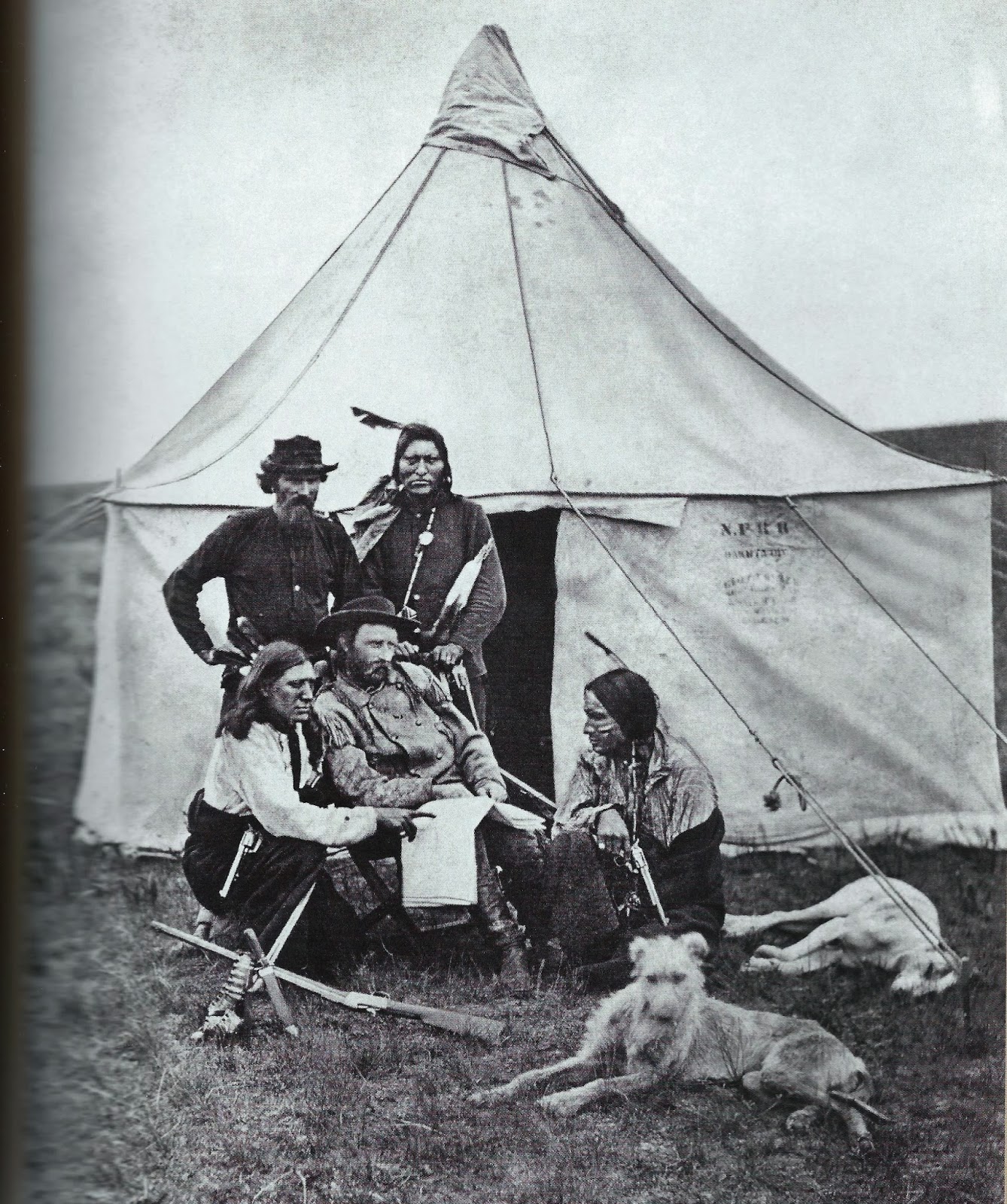
Custer with his scouts 1874-- Library of Congress photo

To understand my cavalry hero for the fourth Oregon historical, I needed to understand the military. When you write about an abstract outlaw, sheriff, rancher, etc., you can play loose with the likely facts but the military has certain absolutes-- or does it? I needed to understand the military of that time. Who better or more written about than George Armstrong Custer?

Some think Custer was made famous by his death at the Little Big Horn. That's not true. He was a celebrity in his own time. His death shocked the nation-- some say as much as JFK's assassination did a later generation. He was politically popular and many think he planned to run for president which considering past candidates isn't impossible. He was immediately blamed for his own actions that day and equally quickly mythologized for the same reason.
 "When a person becomes a model for other people's lives, he has moved into the sphere of being mythologized." Joseph Campbell, The Power of Myth
Yes, he did have an ability to tell his own story in a way that excited others. When you read his own words in the book he wrote about his life on the plains, he was as effusive in praising others as admitting mistakes he himself made. He comes across as a very likeable man. He was however a man who gave orders, expected discipline from others as he did from himself. He was a teetotaler in a group where heavy drinking was more the order of the day. His physical attributes are definitely part of what led to the mythology. The daring man who can ride all night and fight all day is still a powerful hero image.

Certainly after his death, his widow worked to get out stories he hadn't told, to make sure people saw him as a dedicated man who had fought for the good of all. On the positive side, there were others who added to the mythology. In 1877 when interviewed by a reporter for the New York Herald, Sitting Bull told the story of what he remembered of how Custer died.
Sitting Bull: Up where the last fight took place, where the last stand was made, the Long Hair stood like a sheaf of corn with all the ears fallen around him.
Reporter: Not wounded?
Sitting Bull: No.
Reporter: How many stood with him?
Sitting Bull: A few.
Reporter: When did he fall?
Sitting Bull: He killed a man when he fell. He laughed.
Reporter: You mean he cried out.
Sitting Bull: No, he laughed. He had fired his last shot.
Was this the truth? Was Sitting Bull carrying on a mythology which had also been powerful among the tribes? Who can know. There are as many versions of how Custer died as you could find for any famous event in history. The facts that can be agreed upon were that he was a very young man to acquire leadership. He was quite disciplined, strong, athletic and he demanded discipline from those who served under him which was resented.

Some adored him and others hated him. Just before his death he had been called back to Washington to testify at a corruption trial of President Grant's Secretary of War. Custer testified that they were sending inferior food to the reservations as well as the troops. That and other times he had spoken out earned him Grant's enmity. His having to go there at that time, spend time testifying and then waiting to be released to head West was a factor in the failure at the Little Bighorn. He would have rather been training his troops, getting them ready. Instead that fell to Reno who didn't do much about it. The Seventh that went into battle weren't the equivalent of troops he'd taken with him before when he'd had time to toughen and strengthen their skills. 

Some writers, as did Stephen E. Ambrose in Crazy Horse and Custer, recognize the hero but also the fallible human who could make a mistake-- perhaps for political purposes; but then be willing to pay the price. That is courage either way. I liked James Donovan's, A Terrible Glory for how it showed politics as playing a big role in what happened and its aftermath for both the military, the nation, and the Sioux.

When I got through reading the various versions of the Little Big Horn that day, it was clear that nobody could know for sure how Custer himself died. There are a multitude of explanations for how he had been shot twice, his body was stripped, but not mutilated (beyond holes in both ears and some saying they had poked an arrow up his penis... not sure what meaning that had but the ear holes were to make him hear better next time). I'd read he wasn't scalped because he was balding except that made no sense. Custer always had a high forehead. Most books say he had cut his hair short and it explains it. A few have other, juicier explanations.

This research has helped me understand a lot of how my cavalry officer's life would have been. He was a West Pointer like Custer. He also served in the Civil War as well as fought Indians. Although the battles my hero was engaged in were taking place in Oregon and Custer's were out on the Plains, in a fictional sense, they might they have known each other. My hero would have been the older by 7 years.

Whether Custer was a bad guy or a hero is still hotly debated. Yes, after reading so many books (who could possibly read them all), I have an opinion. Between the letters husband and wife exchanged, their own books of their experiences, I also have an opinion on their marriage. Does my opinion on that or Custer's character make any of it fact?


mealtime, Big Creek Kansas 1869 as Elizabeth went with him wherever possible

What I don't think can be debated is that the United States didn't act honorably with how it took the Black Hills, Pahá Sápa, from the Sioux and cheated them in the doing. The quest Custer was on was one assigned him by Grant and Sheridan. One wanted the land. The other wanted Indians killed. Sheridan famously had said the only good Indian was a dead one and that even though, while earlier serving in Oregon, he had had an Indian mistress whom he left to fight in the Civil War. Custer's death served both purposes more admirably than his surviving and gaining even more fame would have. Was there a conspiracy? Who can know but there are those who profited by the emotional anger stirred up at Custer's death and weren't sad to see him out of the way.


Having been to much of this country, where it is said Crazy Horse was born and later secretly buried, I have strong feelings about what happened. It is said in my family that my grandfather was the first white baby born in the illegally taken land of the Black Hills when his father went there to mine for gold. I've often thought if reincarnation is true, maybe I was part of the Sioux people of that time from whom  the land was taken. I have never wanted to go to the Black Hills but have three times climbed Bear Butte which was/is sacred land to the Plains peoples.


Yes, the Plains tribes had to be convinced to stop warring on the white settlers, and it wasn't really possible that the country would cede them all the land they originally had, but how it was done was disgusting. Men like Custer, serving in the military, often paid the price for that wrong doing.

Custer was a romantic hero with many books written about him as well as 94 movies where he was either main character or secondary and 41 documentaries. There is no mid ground with how people see Custer. Mostly he's demonized or portrayed as the gallant hero. Frankly his flaws don't make him one bit less fascinating.

In one of her books, Elizabeth Custer wrote about her last view of her husband and the 7th Cavalry riding away, their musicians playing, The Girl I left Behind Me. Yes, they really did use music even in an attack and it often was Garry Owen. Music is powerful for inciting emotions; so maybe it makes sense why he used it to the point that in a movie you'd think that couldn't be real. Off on that last campaign, she wrote how a mirage seemed to split the troop in two where half appeared to disappear into the sky. An omen that half would soon be killed? There are a lot of mysterious happenings connected to Custer and the Little Bighorn.

They did ride into mythology-- hero and coward alike as later generations try to find better ways to understand what happened that day. Why has it remained so fascinating and why have people sought for years to discover what actually went wrong? Whose fault was it? Could it have ended differently with different choices being made? Today there are many more tools to approach the questions, but are there better answers? Maybe. I will present more in my next blog as I have more to read and am not done with this man.

Tuesday, July 16, 2013

Boots and Saddles

After I saw the list of books Louis L'Amour mentioned, I went looking for one Elizabeth Custer had written-- Boots and Saddles or Life in Dakota with General Custer. I bought it for for my Kindle and started reading right away. It had no photo of her but the Internet is rife with them.

George and Elizabeth Custer with one of their servants

Because I have several times been on the Little Big Horn, feeling the energy of that place so strongly, spending time there to reflect, I have always been interested in stories about the battle, have several books on it including the archaeological evidence that was revealed after a fire had burned off the grass. One book compares the lives of George Custer and Crazy Horse as they moved toward their eventual confrontation.

The battleground memorial is a beautiful place with the feeling that for me is always strongest where big events have happened. I will try to go back when I can, but that probably won't be this year as it's a long way from here. I feel lucky I had been at all as I can still see it all in my imagination even though it's been well over ten years since last I was there.

To read her story of their life together, what it was like to follow her husband from fort to camp, brought a human reality that I had previously been missing. I could so relate to what she experienced and her desire to keep her husband's name and story alive. She is, in so many things, a woman of her time with some aspects that a modern woman won't ever experience or know.

She so loved and admired her husband and hence paints a picture of a loving man of honor and humor while she doesn't ignore the difficulties of a life following the military.

I've heard Custer described as the warrior in the past, but this was the human and  husband side. It makes his loss seem greater than I had previously felt. He became less the legend and more the man-- good at what he did which was being a soldier. She describes him as a brave man and one sympathetic to the Native Americans but bound to do what the country wanted in terms of settling the West and getting the Native Americans onto reservations and stopping predations by them as they tried to hold onto their historic lands.


It was very beneficial for me to read the story as part of the research for the book I soon hope to start which will be more about the life of a cavalry officer-- something, before deciding on the plot for the fourth Oregon historical, that I knew little about. So much of what I saw as romanticized in the movies looks to have been influenced by her writings. There were music and regular balls to break the monotony and difficulty of a life that fought both hostile Sioux as well as the weather which could be equally or even more deadly.

"I had been a subject of conversation among the officers, being the only woman who, as a rule, followed the regiment, and, without discussing it much in my presence, the universal understanding was that any one having me in charge in an emergency where there was imminent danger of my capture should shoot me instantly. While I knew that I was defended by strong hands and brave hearts, the thought of the double danger always flashed into my mind when we were in jeopardy."    Elizabeth Custer.
It is a good story for those interested in memoirs and the historical period after the Civil War and during the settling of the West. Her memoir stops when she learns of her husband's death on the Little Big Horn but is followed by some of his letters to her from earlier campaigns and ends with one written June 22, 1876, three days before he rode into the battle that would be his last.

Boots and Saddles (which is their signal to get onto their horses quickly as trouble is here) is available free in one of the libraries that offers such books scanned, but I found that version too difficult to interpret as scans guess at letters and punctuation. Even the version I bought had some mistakes clearly attributable to scanning, but most had been caught and it was quite readable.

Tuesday, May 7, 2013

Under the Tonto Rim

 "Dusk mantled the forest. A faint night wind arose, mournful and sweet. Lucy threaded her way back toward the clearing. And the peace of the wilderness seemed to have permeated her soul. She was just one little atom in a vast world of struggling humans, like a little pine sapling, lifting itself among millions of its kind toward the light. But that lifting was the great and the beautiful secret."                     from Under the Tonto Rim by Zane Grey

Having said how the books of Zane Grey inspired me toward life values and my own writing, I thought I'd go a bit farther with the why of it. Some say his view of life was too idyllic, not the way of the West as it was. His words often flow more like poetry than prose.  He is praised for the descriptions of the land but belittled for the idyllic view of the relationships between men and women.

When I read his words now (and I own all his westerns, some so old and battered that they are lucky to hold together), it takes me a little to get into them and then it happens as I fall into the flow of the words and images. Once again I begin to feel their energy as it inspires me regarding the land and relationships between humans.


Clearly they have influenced my own value set. The snippet from The Call of the Canyon speaks to a philosophy I have often espoused.
"Carley saw two forces in life-- the destructive and constructive. On the one side greed, selfishness, materialism: on the other generosity, sacrifice and idealism. Which of them built for the future? She saw men as wolves, sharks, snakes, vermin, and opposed to them men as lions and eagles. She saw women who did not inspire men to fare forth to seek, to imagine, to dream, to hope, to work, to fight. She began to have a glimmering of what a woman might be."
As I looked at his books more critically to write about them here, the first big thing I saw explains why he was such an influence on my writing. He didn't consider himself to be a western writer but to be a writer of historical romances. That explains why women were so important in his stories of the West.

Although the women are strong, if not in the beginning, they become thus, I suspect feminists might hate the books which tend to see women as responsible for a lot of what goes wrong in a culture when they adopt materialism, immodest dress, and lack of responsibility in how they use their beauty. On the other hand, they are seen as what will inspire a man to his best. As he portrays them, they are either the downfall or the salvation of a culture; and they can make or ruin a man.

A book like Under the Tonto Rim has an Arizona hero who is a wild-bee hunter. The heroine has come to the valley as a welfare worker to help families learn better ways to live. She does this by living in a cabin tent at the home of one of the families. The hero is the typical romance hero-- tall, muscular, a woodsman and used to living wild. He needs some taming as she also has to come to value the wild. There is a bad guy, but it's really about the beauty of that area and the rural community.

In his stories, Grey wrote about community events that my father used to talk of seeing where his parents would attend community barn dances in South Dakota and the dancing went on until dawn. The children were put into the loft to sleep but they could watch their parents dancing below.

Grey writes of a culture that isn't seen most places any more. The value set though was part of many western communities in the time he wrote with his first book being published in 1903. He wrote 90 books many of which were published after his death in 1939.

Probably a fiction writer of today couldn't write as he did with his poetic phrasing, the condemnation of modern culture, his characterizations of minorities (and boy was he not politically correct even for his time), the desire to go back to nature, and have his level of financial success.

Writers have to fit their times, and his time was open to his style and way of thinking. People wanted to be inspired, to reach to higher values. Critics thought otherwise about his writing, and he wrote how that bothered him.
 "Those critics who crucify me do not guess the littlest part of my sincerity. They must be burned in a blaze. I cannot learn from them."
If his many fans back then had known how he truly [lived his life in terms of the other women], would they have turned on him? Well in those days private lives for celebrities (and he was a celebrity of his time) were more possible. The quotes from his writing reveal black periods which makes me wonder if he was undiagnosed bi-polar, something that wouldn't have been possible to understand in that era. 
"I will see this game of life out to its bitter end."
"I see so much more than I used to see. The effect has been to depress and sadden and hurt me terribly."
Knowing some of this now, the depression he must have suffered, it's amazing the positive feeling that his books project. Some say his wife, Dolly, was a big factor as she was his editor, promoter, mother figure, and perhaps even sometimes co-writer especially where it came to the women. I don't know though because if he had many lovers, he might've understood women better than one would suppose for a man who was supposed to be this great outdoorsman where fishing and hunting were his greatest treasure.

He wrote quite a few books where either a man or woman came to the West, engaged in hard labor and found their soul and deepest core strengthened. It was clearly a belief he had that hard work, nature, time on rivers and in mountains, those were all necessary to living fully. It appears that for him though one woman for a lifetime was not sufficient, and we can ask why, what drove him and how it was reflected in his books. I decided to order the biography, that is reviewed above, as I'd like to understand more about the life behind those books.

Photos all from my trips under the Mogollon Rim and on Tonto Creek

Wednesday, February 1, 2012

Writing a good profile?

Profiles are one thing I really hate to write. My own that is. If you write or have to promote yourself in some way, you probably don't like it much either.  I'd rather everything rested on the books, not about me. There is no choice though as it is part of marketing. I got more interested in doing it when I thought about my writing philosophy.

There was a time when I wrote but never even liked to talk about writing. I just liked to do it. After reading different topics in Kindle Forums, I've had more interest in hearing what other writers think, their philosophies, and what works in their view.

The following is the most recent profile I wrote for Amazon. The photo isn't with it but just playing around with black and white and it seemed like a good one for a writer profile.


A good romance is like a wonderful song for the way it carries the reader along with highs and lows, tension and release, action and waiting. These are the kind of stories I aim to write and also the ones I want to read.

When I have created a story of two people coming together for the first or even second time, finding their connection and also the places they have to let the other go, falling in love and then working out a relationship, I feel a real satisfaction. That's what I hope my readers find also.

A good romance book is being able to reclaim the moment we fell in love through someone else's experience. We want to go along with the roller-coaster ride they are on. My favorite books have elements (sometimes a lot of it) of danger to add to this emotional high. I call mine hybrid romances because they also explore other things that fascinate me which might be art (I am a painter and sculptor), history, science, metaphysics, etc.-- whatever fits the situation these characters have entered into.

When I write, I try to apply the craft I learned from my teachers but also the inspiration I received from all the authors I have ever loved.  I edit, re-edit and edit again leaving slack times between to get fresh perspective. I try to cut out anything not needed. I want my stories to make their point, not be everything that happened, but everything important. I want them to have pace and a destination that leaves the reader and me the writer satisfied. My goal is to provide the wheat and not the chaff, to write a story of yin and yang, darkness and light, softness and hardness and the rose with the thorn.

When defining myself I am an animal, nature loving, rural living woman who is fascinated by both people's stories and their choices. 'Why?' has been a big part of my life. I was born into the foothills of the Cascade Mountains, grew up in the front yard of Sasquatch with wilderness out my backdoor and a gravel road out front. Schooling began in a 2 room country school which meant a mile and a half walk to school along a gravel roads where in the spring I could watch pollywogs turn into frogs.

Today I live on a small ranch in the foothills of the Coast Range of Oregon where my husband and I raise cattle and sheep. The grandchildren come to visit when they can and they are also being raised to love nature, animals, and the outdoors. I don't see my life even now mapped out or where it might be next year. I have always liked living with changes possible.

This is all reflected in my stories which are of love, of men and women finding relationship, and struggling with all the things humans do. Perhaps romantic love has not always been so available but has been in the hearts of men and women from the time they first became recognizably human. We don't have a breeding cycle as so many animals do; so there has to be something to draw us together, make us willing to sacrifice, and that something is not simply lust but a far deeper connection that goes into our souls and some call soul mates. I love to tell the stories of these soul mates.